A few ramblings about knitting, mainly vintage stuff and other bits and bobs. You can buy digital downloads of patterns directly from the site, or head over to either my Etsy store or Payhip

Showing posts with label 1930s. Show all posts

Sunday, 12 January 2025

Bairnswear 30 - Underwear Sets


These are 4 beautiful designs for underwear sets: vest and panties from the early 1930s.
Each one is made for a different size but these are relatively simple garments to up size by adding a pattern repeat or taking the larger or smaller size and working to that stitch count would work out too (probably)

Date: early to mid 1930s

  • Measurements and Materials: from left to right in the pictures 
  • Exquisite (on the front) - bust 36"; hips 39" - Bairnswear Layette Vest Wool 2-ply 5ozs for vest, 6 ozs for panties; 3.75mm US 5 and 2.25mm US 2 needles, ribbon for straps and elastic for panties

  • Orchid - bust 32"; hips 35" - Bairnswear Baby Wool 2-ply 4ozs for vest 4ozs for panties; 3.75mm US 5 and 2.25mm US 2 needles, ribbon for straps and elastic for panties

  • Eve - bust 38"; hips 41" - Bairnswear Baby Wool 2-ply 5ozs for vest 5ozs for panties; 3.75mm US 5 and 2.25mm US 2 needles, ribbon for straps and elastic for panties

  • Elegance - bust 30"; hips 33" - Bairnswear Layette Vest Wool 2-ply 4ozs in blue and 1oz in pink for vest, 5 ozs of blue and 1 oz in pink for panties; 3.75mm US 5 and 2.25mm US 2 needles, ribbon for straps and elastic for panties


Orchid - 32" bust

Eve - 38" bust

Elegance - 30" bust

Thursday, 2 January 2025

Jaeger 573 - Lacy Afternoon Blouse


Buy Now 


This great mid 1930s patterns used odd sized needles to produce an openwork or drawn thread look. It works up quickly and looks fabulous. I mean, just look at the points to that collar


Date: mid 1930s


Measurements: bust 32 to 34"; length 18"; sleeve seam 5"


Materials: 3-ply or light fingering; 3.25mm US 3, 7.5mm US 11, and 5mm US 8 needles

Original used 3 ozs Jaeger Feather Fleck


Tension: 7 stitches and 8 rows to 2 inches (possibly over pattern)


5 Pages

Monday, 26 February 2024

1930s Belted Cardigan


Belted Cardigan

This is a great late 1930s cardigan in a good modern size. The short cardigan has wrap over sides and it held in place with a belted tie.

This pattern does not have any tension or gauge advice

Date: late 1930s

Measurements: bust 36 to 37"; length 18"; sleeve seam 17"

Materials: aran or worsted and 3-ply or light fingering; 4.5mm US 7 and 3.75mm US 5 needles
Original used 7 ozs of tweed effect wool and a little 3-ply wool in a colour to match

Sunday, 25 February 2024

Stitchcraft February 1933 - The Chic of Check


Stitchcraft February 1933 - The Chic of Check

This is wonderful - that deep ribbing around the waist and cuffs and the check just sets it all off

Measurements: Bust 34"; Length 18"; sleeve seam 18"

Materials: 4-ply or fingering; 3mm US 2.5 and 3.25mm US 3 needles; 7 buttons
Original used 6 ozs brown and 4 ozs natural Patons Super Scotch Fingering 4-ply

Tension: 8 stitches to 1 inch using 3.25mm needles

Language Note
This pattern had a word commonly used to describe dark brown for much of the 20th century: the N-word. I have edited it from the pattern and substituted with the word ‘dark’. The original pattern was a product of its time, and although the word is not being used in a racially hateful way, it allowed prejudices to continue. By editing the word I hope that I am not suggesting that these prejudices never existed, merely that they are not acceptable today (nor were they in the past).

Sunday, 28 February 2021

Spring to Summer Knitting - Free Pattern


Knitting for Spring and Summer can seem like a weird thing. Wool is warm so why use it for the warmer months? It's used because it is also a great insulator and regulator of heat.

I could bore you silly with my explanation of how modern sheep have been bred them to have thick fleeces but their ancient counterparts had scraggly locks that would fall naturally but that's something for another day. Instead I shall share this lovely jumper with you from the early 1930s. 

The pattern says the model is Nancy Carroll who was an actor active in Hollywood from 1927 to 1938. I think this was from her most popular times so will date this from 1932 to 1934. She received the most fan mail of any actor of the early 30s (according the Wikipedia) but was 'difficult' so was released from her contract and was no longer considered an A-lister.

To get the pattern, just click on the image and it will take you to the pdf.

A Summer Day Jumper

The Lady Needlework Book No. 2

34 and 36" bust; length 20"; sleeve seam 5" - for 36" bust use 3.75mm US 5 instead of 3.25mm US 3

Original used 6ozs Beehive Fingering 3-ply in pale green


Wednesday, 5 June 2019

Easy and Quick . . .

Front of knitted lace jumper from the 1930s in blue aran wool
. . . . well until I get distracted again and start something else.

I have been working on a pinwheel cardigan and it's gorgeous but it takes so long to go round now I wanted a rest. And I found this wonderful late 1930s beauty to give me some quick and easy relief.

It's a great blouse that is made from thick yarn and big needles so shouldn't take too long to make. I have 2 of those huge 400g balls of aran something with wool and hunted down my 7mm needles and away I went. In just over a day I have made the front so if I'm lucky I might even get to finish is this weekend.


Friday, 31 May 2019

Free Pattern Friday - 1930s Garter Stitch Jacket

1930s lady wearing a garter stitch jacket and beret
How wonderfully chic is this gorgeous jacket? I love it as it subverts the idea that older clothing was knit in a standard way. The body is worked from side to side, decreasing slight under the arms then increasing for the back so it sits right. Once you've done that you pick up the stitches along the top of the body for the yoke. Finally you knit the arms and just sew everything together. The pattern suggests patch pockets of garter stitch but placed across the body to make them stand out. 

It's a lovely early 1930s example of knitted perfection (there are a lot I know). As knit, it's for a 36" bust - using 4-ply on 3.25mm US 5 needles, but I think that increasing the weight of the yarn and the needle size might bring it up to a couple of inches. To be frank, the pattern is that simple that it would only take a little bit of maths to make it larger using 4-ply. 

If you'd like a copy, click on the link below and knit your own 
Garter Stitch Jacket

Friday, 10 May 2019

Free Pattern Friday - A 1930s Crochet Gnome Cap

1930s spikey crochet cap for ladies

I love this sweet crochet cap. I realise that it's meant to be chic and smart but I kind of like the idea that it's a dragon or dinosaur cap. I might make one up to see how it look. Reading through the pattern, I think it needs an aran weight - the original says 3-ply held double but there is no indication of the hook size so you might have to play around until you get the right hand.

Click below to download the pattern and please post here if you do make it up as I think that it's great fun

Friday, 3 May 2019

Free Pattern Friday - A 1930s Bathing Dress

1930s bathing dress swinsuit

Knit yourself a fabulous bathing dress and be part of the 'Bright Young Things' set. Throughout the late 1920s and early 30s magazines showed the glamorous side of life and fashion changes from the 1920s meant that women were not restricted with their clothing as previously. This meant that legs were seen for the first time and not just in the privacy of your home, you could go out to the lido or beach and strut your stuff for the world to see. 

Suddenly there was the need for a garment that covered the important bits but gave you the freedom to play. This dress is in 2 parts: the long-line vest with a pair of knitted panties underneath, but there are also instructions on how to join them if you wanted a bit more security or to stop you from losing your kecks when swimming. 

You have to wonder how practical a woolen swimming costume would be but they were incredibly popular so women must have been willing to put up the any slips that happened. I also like that women of every size took the opportunity to embrace the fashion. From this photo, I think that the women were actually swimming and their hair is under wraps and they obviously gave no figs about what others thought.

So if you give no figs either, or just want to revel in the glamour of the 1930s then have a go at the pattern - just click on the link below

Wednesday, 27 April 2016

Spring is Springing . . .

https://drive.google.com/file/d/0B_tfKoGu9l5BS2wyeHpaUXFDNmc/view?usp=sharing
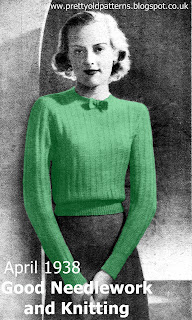
. . . and what better way to celebrate than with this great Spring Jumper from Good Needlework and Knitting 1938? 
Worked in a fancy rib with lovely long, close fitting sleeves and a  wee bow at the neck this is a classic 1930s design and will fit up to a 35" bust.
I love how a colour scheme is given for your whole outfit. Soft Tulip Green is suggested with a matching green angora woollen skirt; brown shoes; suntan stockings; and brown, green and yellow bangles. I like to think that those bangles are the big, chunky Bakelite ones that stack half way up your arm.

The second colour scheme is no less vibrant being Poker Red but toned down with a grey flannel skirt and jacket, grey suede shoes and belt and natural stockings.

Unusually the sleeves are worked from the top down so this could easily be made with shorter sleeves if you choose.

To download the pattern, just click on the image above


Friday, 25 March 2016

Family Woollies and a bit of history

Family Woollies
 I love these knitting supplements - this one was produced by Texet for Mother and Home in about 1937. Not only do you get a range of patterns also get a teeny glimpse of what was 'socially' acceptable for that era - history and knitting in one happy bundle. This one has the perfect nuclear family for the 1930s: Mum and Dad and 3 children and reflected the British government's attempts to raise the population.

Although it may not seem like an obvious campaign, images of the ideal family across a range of media presented what was desirable and in 1930s Britain, a larger family was desirable. Having a large population in the early part of the 20th century was seen as a positive thing as people were needed to work in manufacturing and agriculture but also meant that you had a population to buy the goods you made.

During the First World War the UK population had slumped and although there was a significant spike immediately afterwards, the birth rate soon dropped again. By the late 1920s the number of births had dropped to current levels, about 700,000 a year, and infant morality meant that 1 in 10 children didn't survive to their first birthdays so subtle campaigns throughout the 1930s were designed to encourage larger families (but not too large). These feed into all aspects of normal life including knitting patterns.

So there you have it: a little bit of history and a little bit of knitting - click on the cover and download the booklet with 9 family designs


Thursday, 14 January 2016

New In

I had a bit of a 30s splurge this week (it's probably my favourite era style wise). First was a great diagonal striped jumper with a stylish jabot (or decorative ruffle) from Munrospun from the mid 1930s. Munrospun was one of those companies that always produced high end patterns and was seen as being slightly more chic than many of the standard pattern companies. The pattern is for a 36" bust and uses a 4-ply so I think it could easily be resized by using larger needles and thicker wool. Then there is this wonderful lace blouse with a bust measurement of between 33" to 36" depending on how tight you like your clothes. The original was made from an artificial silk or rayon so if you want to match the drape, make sure that you choose something that slips.

This set of 5 jumpers, all different sizes that come from the Good Housekeeping Second Knitting Supplement. I found this tucked into a modern book and was so surprised to find it. The patterns are wonderful and probably date from the early 30s judging by the hair styles. My favourite is the diagonal striped jumper: I love the way they carry on through to the back and the way that one of the stripes coils down the arm. Each jumper has only one size but they are different, so a crafty use of different needles and yarn weights could get you a larger or smaller version. However, no tension is given so you really will just have to see how they feel.


On to the 1940s and there is this stunning cable and bobble twin set in a great petite size. To make this larger, just increase the number of repeats, but remember that you might also need to alter the arm scyth too so you could use a pattern in your size to work out that one.

For those of you that like a bit of lace, there is this gorgeous lace jumper pattern, also in a more petite size. This is a Bairnswear pattern, La Laine is the wool needed. Bairnwear did this frequently but probably the most recognised if 'Femina' which was another one of their wool lines.


My final 1940s pattern is this wonderful puff sleeve blouse or evening jacket with an all over shirred design. This one was designed by Munrospun and is, I think, extremely beautiful. I can just imagine it in a midnight blue yarn with a bit of glimmer to it and crystal buttons. The shirring is easy to achieve: it's just a matter of increasing and decreasing at the appropriate points to get the ripple effect.

To finish there is this fun 1950s 'sweater girl' jumper pattern with a nice open mesh lace. This is achieved by using a large (10mm) needle every few rows. This pattern has 2 sizes 34" and 36" but I think that it might be tricky to make it larger by just using larger needles or yarn so you might have to work out the maths if you want to resize it. 


Thursday, 7 January 2016

New lovelies

As part of my new year's resolutions I am going to add one pattern to the shop every day. Granted, it's only been a week but it's going really well. I decided to go for a mix of different style and eras so there's something for everyone (as long as you like ladies' patterns).

There are these fabulous 1930s designs. The Patons jumper is for a 34" bust but should be easy to resize as you can just add another pattern repeat to make it larger. Alternative, you could use a slightly heavier yarn and slightly needles to take it up a few more inches.

The Woman's Weekly stretches to 40" bust (despite the sylphlike model)  and has a great lace pattern. I made one of these beauties last year and it's fabulous. I went up to a 4-ply yarn and used 4mm needles instead of using 3.75mm to get a larger size. My measurements when the photo was taken was a 49" full bust and 42" waist so you see it adapts very nicely to a larger size.

I also included some great and easy to make jumpers from the 1940s, just check out those victory rolls. The Bestway pattern was reprinted with slightly changes until the mid 1950s (I'll do a post later about that) and has a lovely lace pattern. 

The striped pullover from Copley's has a slipped stitch which gives it a slight lace look. I love that the Copley's changed their logo during the war. Pre-war it was a bellboy but during the war, they gave him a tin hat.

A mainstay of British patterns until the 1970s is the bed-jacket. Most homes until the 1980s, and even the 1990s, didn't have central heating so you had to find something to keep you warm whilst reading in bed or before dressing in the morning.

These 2 patterns are light and lacy and look amazingly glamorous. Every woman needs a bed-jacket and you can always use them as a light cardigan for those chilly summer evenings.

The final pattern for the week is this cardigan and jumper set from Twilleys. Both have fabulous deep v-neck and I love the contrast round the neck and welts. I think these made from a soft 4-ply cotton would be wonderful for summer.

All the patterns have already been entered on to the Ravelry database.


Saturday, 20 September 2014

Sunny Saturday Free Pattern


This is just what every woman should want for winter - her own pixie hat.

This great pattern is from the early 1930s and originally made from angora. You could try alpaca or even one of those bonkers fun yarns for a modern twist or stick to the beautiful yarn that is angora.

I know that some people have a bit of  problem with angora since there are some issues, in some places, with production standards but there are so many beautiful angora yarns out there from artisan suppliers who have the highest standards of animal welfare so is you get the chance have a fondle of this fibre.

This is so quick to make up as it's basically a rectangle with a neck band but it's such a fun hat that you could production line them and one for every person you know

Click below for the pattern and have all the fun making the classic Pixie Hat

Monday, 18 August 2014

Bestway 741 - How to Re-Foot Socks


I was sorting through yet more patterns and came across this great pattern on how to re-foot socks. I'm not sure how old it is: the style looks like its from the late 1930s. We’re probably most used to the idea of Make Do and Mend from WWII and this pattern perfectly sums up that spirit. The technique can be used for any hand knit sock so now you don’t have the throw away those socks that have gone too far to darn.

Just clink on the image and get the pattern for yourself and see for yourself just how easy it is to repair a sock with manky toes or heels. 

There’s also a pattern for a complete pair of men’s socks (which let’s face it, anyone can wear) on the back. And a handy photo tutorial to help you along the way.

I've made the socks and they are great, although I did half the amount of leg ribbing as I only had 100g of wool but they fit brilliantly.