The man was a god among men. I think he was one of the most creative individuals I have every come across. He challenged so many things and showed others how to explore the world around them on their own terms. He showed that style and substance could go together.
Also, as Ziggy, he could rock a knitted body suit like no other person.
He will be sorely missed
A few ramblings about knitting, mainly vintage stuff and other bits and bobs. You can buy digital downloads of patterns directly from the site, or head over to either my Etsy store or Payhip
Showing posts with label knitting. Show all posts
Monday, 11 January 2016
Saturday, 4 April 2015
No idea
No idea what size this was going to come out
No idea if I’d have enough wool
Since there was no gauge given on the pattern and it’s vintage double knit and 3-ply I had no idea what to aim for, especially as it is on 5.5mm needles but I did this on 5mm as the 5.5mm was too loose.
I've loved this pattern for ages. It's taken from The Pictorial Guide to Modern Home Knitting, edited by Catherine Franks, which was published by Odhams in 1939 originally and then quickly reprinted in 1940. The book is marvellous and well worth hunting down a copy as it has lots of lovely vintage patterns but is more a book on how to make your own patterns.
Anyway, this jumper. I had some old Patons Clansman but only 250 grams so knew that I was unlikely to get an entire garment from it so had thought about mixing it with another yarn to bulk it up a bit and make it go that little bit further. Then I remembered this pattern and realised that it would be perfect. A quick hunt through my stash brought up some Hayfield Courtelle 4-ply and I was away.
I followed the pattern to start with but quickly realised that by dropping half a needle size, it was going to be too small so unravelled what I had and started again but added 10 more stitches to the cast on (the body is worked from side to side) and increased the number of stitches cast on to make up the edge of the armholes. I also added an extra set of stripes to the body to counteract the smaller needles.
The waist ribbing was picked up across the bottom making sure it was kept nice and loose as it would need to keep some stretch.
The sleeves were a bit trick as I was getting short of wool. I considered making them shorter but it looked wrong and shifted the pattern from a classic late 30s style into the bubble style of the 80s. I did the cuffs first then worked the sleeves top down, grafting them together.
I finished the sewing up with about a metre of the brown wool left over, Phew!
Since I couldn't find any buttons for the front to match the green wool, I crocheted some covers and slipped them on.
The original jumper doesn't have the buttoned neckline, but when this was being made it seemed quite tight and I was worried that there wouldn't be space for a head. After washing it though, it loosened up and now has a lovely drape to the cowl front and shows the green wool better.
Finished measurements (laid flat):Bust 35”, waist 24”, length 20” and although it's too small for me, it's ideal for a wonderful friend who loves the vintage look and wearing unusual clothes
No idea if I’d have enough wool
Since there was no gauge given on the pattern and it’s vintage double knit and 3-ply I had no idea what to aim for, especially as it is on 5.5mm needles but I did this on 5mm as the 5.5mm was too loose.
I've loved this pattern for ages. It's taken from The Pictorial Guide to Modern Home Knitting, edited by Catherine Franks, which was published by Odhams in 1939 originally and then quickly reprinted in 1940. The book is marvellous and well worth hunting down a copy as it has lots of lovely vintage patterns but is more a book on how to make your own patterns.
Anyway, this jumper. I had some old Patons Clansman but only 250 grams so knew that I was unlikely to get an entire garment from it so had thought about mixing it with another yarn to bulk it up a bit and make it go that little bit further. Then I remembered this pattern and realised that it would be perfect. A quick hunt through my stash brought up some Hayfield Courtelle 4-ply and I was away.
I followed the pattern to start with but quickly realised that by dropping half a needle size, it was going to be too small so unravelled what I had and started again but added 10 more stitches to the cast on (the body is worked from side to side) and increased the number of stitches cast on to make up the edge of the armholes. I also added an extra set of stripes to the body to counteract the smaller needles.The waist ribbing was picked up across the bottom making sure it was kept nice and loose as it would need to keep some stretch.
The sleeves were a bit trick as I was getting short of wool. I considered making them shorter but it looked wrong and shifted the pattern from a classic late 30s style into the bubble style of the 80s. I did the cuffs first then worked the sleeves top down, grafting them together.
I finished the sewing up with about a metre of the brown wool left over, Phew!
Since I couldn't find any buttons for the front to match the green wool, I crocheted some covers and slipped them on.
The original jumper doesn't have the buttoned neckline, but when this was being made it seemed quite tight and I was worried that there wouldn't be space for a head. After washing it though, it loosened up and now has a lovely drape to the cowl front and shows the green wool better.Finished measurements (laid flat):Bust 35”, waist 24”, length 20” and although it's too small for me, it's ideal for a wonderful friend who loves the vintage look and wearing unusual clothes
Monday, 9 March 2015
Pin and Needles - the ultimate craft magazine
In September 1949 a new craft magazine hit the newsagents and it's name was PINS AND NEEDLES. With their bold and bright, almost cartoon like, covers, it must have been refreshing to see in the post war era.
There had been craft magazines before, most famously Stitchcraft, but nothing that had covered the range of crafts that Christine Veasey imagined for hers. I have 49 copies of this wonderful magazine ranging from the first edition until to No. 167 for December 1966. Published quarterly until November 1952 it then went bi-monthly. By March 1955 it had become successful enough to go to being a monthly publication which it continued to be into the 1980s (but under a different editor and company).
Initially it was mainly knitting and crochet with a bit of needlework or embroidery. There was the occasional wood working project, usually furniture but sometimes toys or garden items. As time passed, the subjects spread to include dress making, tatting, hair pin lace, and cooking. There was always a good coverage new sewing patterns that you could buy directly from the magazine offices. Christine Veasay went to America on regular trips and brought back ideas that were new and fresh and translated them to the British sense of taste.
In March 1955 a section called Home Making was introduced. Britain suffered a severe housing shortage during and after the Second World War but by 1951 houses were springing up all over the UK. Although a great many were council owned, tenants could decorate them as they chose and Pins and Needles was there to help. They offered decorating advice, what the latest colour schemes were, how to renovate old furniture, how to build new furniture: everything to make your house modern. Within a few months, the Home Making section had been re-branded into Weekend Workshop which was aimed more at men with 'Bertie Buggetwise' as their guide to making everything from glass topped coffee tables to built in wardrobes, and advice on how to plumb in sinks and put up tv aerials.
Unlike Stitchcraft which was marketed by Patons and Baldwins to sell their yarns, Pins and Needles had to rely on other sources of income namely advertisers. Initially it was mainly yarn and handicraft suppliers with the odd advert for a knitting or sewing machine but as the years progressed more and more general catalogues, along with calls for people to become agents for them, became common. Whereas the early advertisers stressed their value for money and quality product, the latter ones start offering credit as a means of payment and offering the latest this and the newest that, possibly paving the way to the economic crash of 1973.
Aside from it being a crafting magazine, it also documented the changes that the British people were undergoing and reflected not just fashion trends but social and economic ones too. The Britain of the late 1940s was one of hardship, rationing and a country coming to terms with the cost, both financially and socially, of a global war. By 1957, full employment, a rise in consumerism, wages, and export led Harold MacMillan to make his 'never had it so good' speech and Britain was booming.
Saturday, 7 March 2015
Pins and Needles Covers
The covers of Pins and Needles
|
No. 1 Winter 1949
|
No. 11 Summer 1952
|
|
No. 12 Autumn 1952
|
No. 15 March 1953
|
|
No. 17 July 1953
|
No. 18 September 1953
|
|
No. 19 November 1953
|
No. 20 January 1954
|
|
No. 22 May 1954
|
No. 27 March 1955
|
|
No. 29 May 1955
|
No. 32 August 1955
|
|
No. 35 November 1955
|
No. 36 December 1955
|
|
No. 37 January 1956
|
No. 39 March 1956
|
|
No. 40 April 1956
|
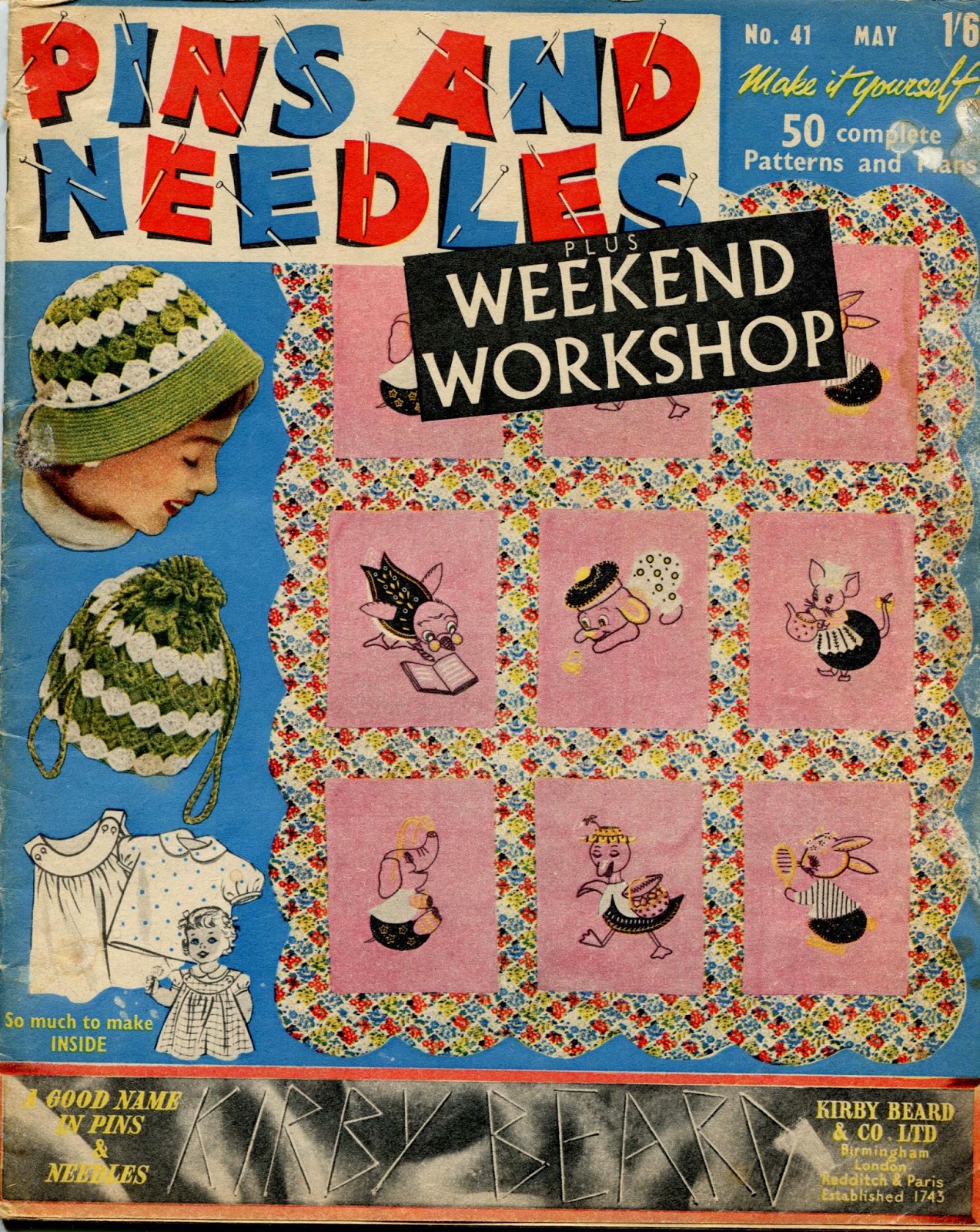
No. 41 May 1956
|
|
No. 49 January 1957
|
No. 52 April 1957
|
|
No. 53 May 1957
|
No. 56 August 1957
|
|
No. 58 October 1957
|
No. 59 November 1957
|
|
No. 60 December 1957
|
No. 61 January 1958
|
|
No. 62 February 1958
|
No. 63 March 1958
|
|
No. 64 April 1958
|
No. 65 May 1958
|
|
No. 66 June 1958
|
No. 68 August 1958
|
|
No. 69 September 1958
|
No. 72 December 1958
|
|
No. 74 February 1959
|
No. 75 March 1959
|
|
No. 76 April 1959
|
No. 82 October 1959
|
|
No. 83 November/December 1959
|
No. 86 March 1960
|
|
No. 92 September 1960
|
No. 98 March 1961
|
|
No. 99 April 1961
No. 121 February 1963
No. 153 October 1965
No. 167 December 1966
|
No. 105 October 1961
No. 124 May 1963
No. 165 November 1966
|
Subscribe to:
Posts (Atom)