
No. 1 Winter 1949
|

No. 11 Summer 1952
|

No. 12 Autumn 1952
|

No. 15 March 1953
|

No. 17 July 1953
|

No. 18 September 1953
|

No. 19 November 1953
|

No. 20 January 1954
|

No. 22 May 1954
|

No. 27 March 1955
|

No. 29 May 1955
|

No. 32 August 1955
|

No. 35 November 1955
|

No. 36 December 1955
|

No. 37 January 1956
|

No. 39 March 1956
|

No. 40 April 1956
|
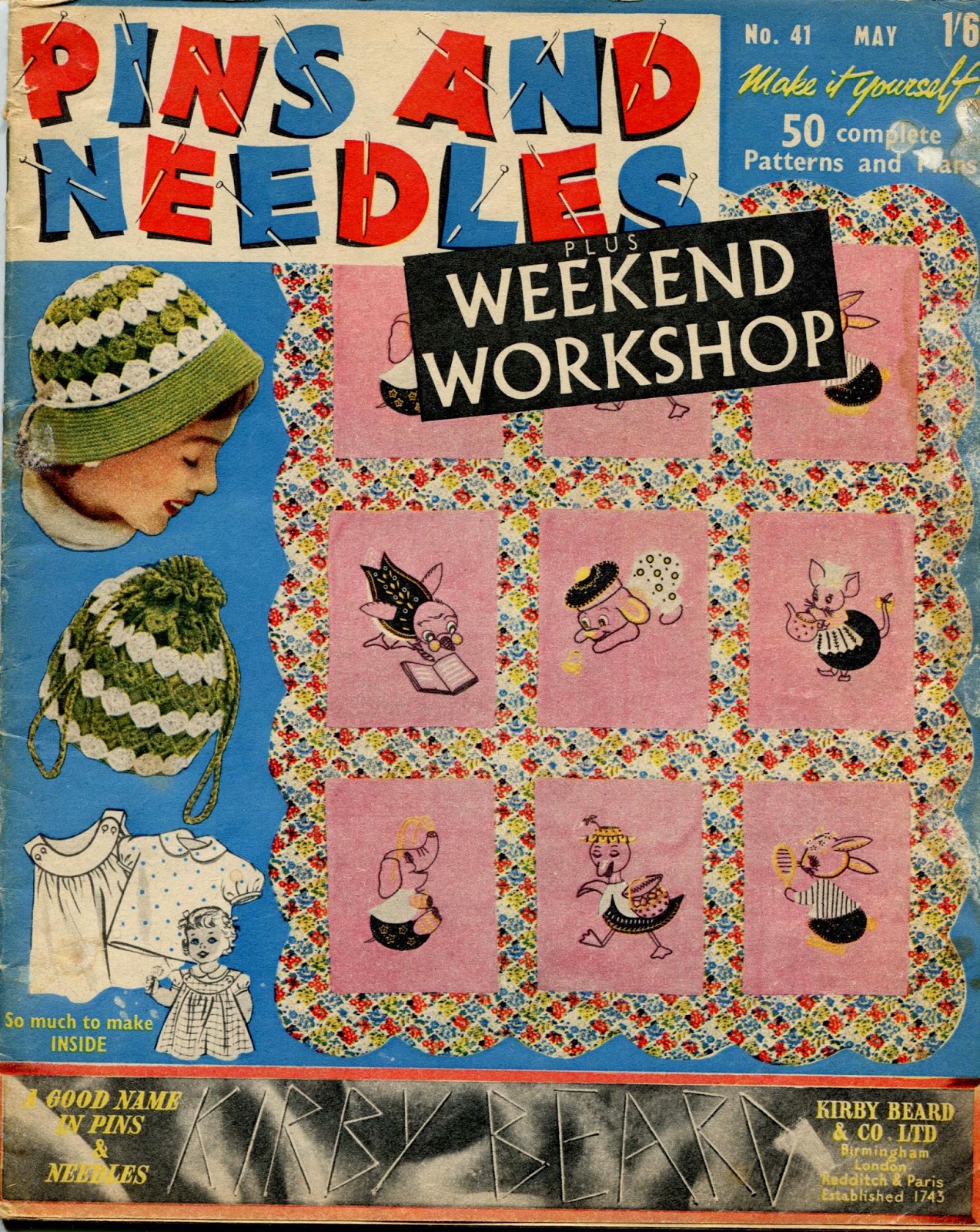
No. 41 May 1956
|

No. 49 January 1957
|

No. 52 April 1957
|

No. 53 May 1957
|

No. 56 August 1957
|

No. 58 October 1957
|

No. 59 November 1957
|

No. 60 December 1957
|

No. 61 January 1958
|

No. 62 February 1958
|

No. 63 March 1958
|

No. 64 April 1958
|

No. 65 May 1958
|

No. 66 June 1958
|

No. 68 August 1958
|

No. 69 September 1958
|

No. 72 December 1958
|

No. 74 February 1959
|

No. 75 March 1959
|

No. 76 April 1959
|

No. 82 October 1959
|

No. 83 November/December 1959
|

No. 86 March 1960
|

No. 92 September 1960
|

No. 98 March 1961
|

No. 99 April 1961

No. 121 February 1963

No. 153 October 1965

No. 167 December 1966
|

No. 105 October 1961

No. 124 May 1963

No. 165 November 1966
|

Saturday, 7 March 2015
Pins and Needles Covers
The covers of Pins and Needles

Sunday, 15 February 2015
With Spring nearly here . . Marriner's 443

This pattern from Marriner (No. 443) is such a pretty summer blouse and comes in 4 sizes so can be easily sized up a couple more inches either by altering the weight of the wool and or needles sizes to fit a larger size. If you do go this route, make sure you don't use a yarn that's too heavy as it could alter the drape of the blouse and you'll just get left with a saggy mess (ask me how I know).
The original wool was a relatively lightweight 3-ply and the tension 7.5 stitches to 1 inch. Increasing the tension size to 7 stitches per inch will give you approximately 1 inch gain over the width of the jumper. 6.5 to 1 inch will add 2 inches or 4 inches overall but I think that this might make the yoke huge and you'd lose the lovely ribbing at the neck so perhaps it's time to grab your adventurer's pants and crack out the calculator and grade the pattern up to the size you want.
With muti-size patterns it's easier than you think and using a spreadsheet programme to get the calculations right means you can see across the whole range to see if anything look wrong. To start you need to read through the whole pattern and mark where numbers change. Rather than write out all the figures, here's the link to the google doc I used with some notes to hopefully explain better. I've used the established numbers for bust sizes 32" to 38" to take the pattern up to 40", 42", 44", and 46"
For the purpose of this, I've assumed that most larger women are larger overall, so bigger waists, bigger arms and wider necks and bigger busts. If you are slender but have a large bust, you could use the smaller sizes for the casting on and then increase to the larger sizes or use bust shaping to get to the required number of stitches for the yoke.
Like most knitting, the proof is in the making and I have not made this up so please use the figures with caution and if you see any glaring errors please comment so I can update the chart.
To download the pattern, please click on the pattern cover above.
Friday, 13 February 2015
Happy Valentine's Day

Code is valid until 17th February so you have the whole weekend to find something that gives you a thrill
Friday, 30 January 2015
A Hat for A Head - Patons 814 Free Download

The fashion for shorter hair styles and less frou-frou paved the way with film stars and socialites needing something to keep their locks sleek. Mass media gave everyone a chance to copy the trend and the place of the turban in British fashion history was set. By the 1940s they were everywhere: in films, fashion, newspapers, adverts.
 When rationing slowed, and then stopped, the availability of millinery
supplies, women got creative with their headwear and took the turban to new
heights (quite literally) as there was still a need for a good, warm, and
practical hat that was easy to wear, required no pins to hold it, and could
be made with the supplies at hand. And knitting stepped up. Some patterns were
no more than wide strip of loose knitting wrapped and tied but others became a
little more elaborate. The pattern here has 3 versions: a plain wrap, a twisted
wrap and then one with a crown which makes a more formal hat.
The crown one uses 2 strands of 4-ply worked together, or you could use an aran weight yarn as I have done here. It takes less than 100g, this one took 79g of an acrylic and wool mix and works up very quickly, in fact you may spend longer arranging the knot that actually knitting it.
To download the pattern please click on the link below
3 Turbans in Carin Rimple Wool
.
Sunday, 25 January 2015
Knitting shops now gone
I've long been intrigued by the number of knitting shops that used to populated the UK. Talking to older people has made me realise that just about every town had somewhere to buy wool no matter how small so last year made a start on logging them on Google Maps.
The locations come from the stamps that shops put on the patterns, usually on the front cover, but sometimes on the inside. There are a few that I can't find, the red dots, but hope that by the time I've gone through my entire collection I might have worked out where they are.
This is a work in progress so hopefully the map with gather more pink dots and show just how widespread wool and craft shops were. My dream is to find a shop that is pre 1969 and still open.
Saturday, 3 January 2015
New Year, New Project


So I am now working on this lace cardigan worked on 3.75mm needles so it's nice and open without being loose. I'm still a bit worried about running out of wool but figure if I can get the back, fronts, and button band sorted, I'll work the sleeves together from the top down so will stop when I run out. What could possibly go wrong?
Thursday, 1 January 2015
Birthday Sharing

Happy New Year Lovelies and thank for your support since I opened the shop in February. To celebrate my birthday on the 13th I am giving everyone a discount of 25% on anything for the whole of January. You can use the coupon as many times as you like and I plan on adding lots more patterns, both downloads and originals so there is bound to be something that you like. I might even get round to adding some sewing patterns.
Just use the discount code BIRTHDAYSALE25 at the checkout and please pass this offer on to anyone you think might be interested.
Pretty Old Patterns
Subscribe to:
Posts (Atom)