A few ramblings about knitting, mainly vintage stuff and other bits and bobs. You can buy digital downloads of patterns directly from the site, or head over to either my Etsy store or Payhip

Sunday, 17 January 2016

Surprise Sunday - 1940s Fair Isle Gloves

Since this was the scene that greeted me this morning, I thought that we could all do with a quick and pretty pattern  to help keep the cold away so I came up with gloves and mittens (all fitting an average hand, whatever that is). They are all made with quite a tight tension to keep your hands nice and warm. 

https://drive.google.com/file/d/0B_tfKoGu9l5BUHZzMjBMYWZ6WlU/view?usp=sharingEach pair use only an ounce (about 28g) of the main colour with the pattern being made up from oddments. Model A uses white, clover, lilac, rose, green, and peach as the contrasts. You can use what ever colours you have about as I think that it's probably only a few metres of each that you'll need for both gloves. Although the originals use 3-ply one of the thinner 4-ply wools would work equally well as long as you get the tension of 10.5 stitches to 1" using 2.75mm US 2 needles. Model B are the mittens and have this lovely toning patterns across the back of the hands in a light, medium and dark shade. The tension of these are a little bit tighter: 11 stitches to the inch using 2.75mm US 2 needles. Model C has brown, green, red, white, lemon and yellow and are worked as a tension of 10.5 stitches to 1 inch using 3mm US 2 needles.
To down load the pattern just click on the pattern and it should take you to the pdf.


Thursday, 14 January 2016

New In

I had a bit of a 30s splurge this week (it's probably my favourite era style wise). First was a great diagonal striped jumper with a stylish jabot (or decorative ruffle) from Munrospun from the mid 1930s. Munrospun was one of those companies that always produced high end patterns and was seen as being slightly more chic than many of the standard pattern companies. The pattern is for a 36" bust and uses a 4-ply so I think it could easily be resized by using larger needles and thicker wool. Then there is this wonderful lace blouse with a bust measurement of between 33" to 36" depending on how tight you like your clothes. The original was made from an artificial silk or rayon so if you want to match the drape, make sure that you choose something that slips.

This set of 5 jumpers, all different sizes that come from the Good Housekeeping Second Knitting Supplement. I found this tucked into a modern book and was so surprised to find it. The patterns are wonderful and probably date from the early 30s judging by the hair styles. My favourite is the diagonal striped jumper: I love the way they carry on through to the back and the way that one of the stripes coils down the arm. Each jumper has only one size but they are different, so a crafty use of different needles and yarn weights could get you a larger or smaller version. However, no tension is given so you really will just have to see how they feel.


On to the 1940s and there is this stunning cable and bobble twin set in a great petite size. To make this larger, just increase the number of repeats, but remember that you might also need to alter the arm scyth too so you could use a pattern in your size to work out that one.

For those of you that like a bit of lace, there is this gorgeous lace jumper pattern, also in a more petite size. This is a Bairnswear pattern, La Laine is the wool needed. Bairnwear did this frequently but probably the most recognised if 'Femina' which was another one of their wool lines.


My final 1940s pattern is this wonderful puff sleeve blouse or evening jacket with an all over shirred design. This one was designed by Munrospun and is, I think, extremely beautiful. I can just imagine it in a midnight blue yarn with a bit of glimmer to it and crystal buttons. The shirring is easy to achieve: it's just a matter of increasing and decreasing at the appropriate points to get the ripple effect.

To finish there is this fun 1950s 'sweater girl' jumper pattern with a nice open mesh lace. This is achieved by using a large (10mm) needle every few rows. This pattern has 2 sizes 34" and 36" but I think that it might be tricky to make it larger by just using larger needles or yarn so you might have to work out the maths if you want to resize it. 


Monday, 11 January 2016

R.I.P. David Bowie

The man was a god among men. I think he was one of the most creative individuals I have every come across. He challenged so many things and showed others how to explore the world around them on their own terms. He showed that style and substance could go together.

Also, as Ziggy, he could rock a knitted body suit like no other person.


He will be sorely missed

Sunday, 10 January 2016

Surprise Sunday - 1950s Batwing Bolero - Bestway A2749

The pattern is for a 34" to 36" bust and has a simple basket stitch pattern and is worked in a 3-ply or light fingering. It also has a shirt collar and fastens at the neck with a single button although to could leave this off if you want. There are instructions for either long or 3/4 length sleeves.

As it's worked on small needles, if you wanted this to be larger, you could go up a needle size without compromising the hand of the garment, or even use a 4-ply with a larger size needle to get a few extra inches.

Measurements: 34" to 36" bust; length from shoulder 15.5"; three-quarter sleeve seam 11.5"; long sleeve seam 18"

Tension: Over the pattern 17 stitches and 22 rows to 2 inches using 3mm US 2.5 needles

Materials: 8ozs Emu Zephyr 3-ply Botany Wool; 3mm US 2.5, 2.75mm US 2, and 2mm US 0 needles; 1 button


Thursday, 7 January 2016

New lovelies

As part of my new year's resolutions I am going to add one pattern to the shop every day. Granted, it's only been a week but it's going really well. I decided to go for a mix of different style and eras so there's something for everyone (as long as you like ladies' patterns).

There are these fabulous 1930s designs. The Patons jumper is for a 34" bust but should be easy to resize as you can just add another pattern repeat to make it larger. Alternative, you could use a slightly heavier yarn and slightly needles to take it up a few more inches.

The Woman's Weekly stretches to 40" bust (despite the sylphlike model)  and has a great lace pattern. I made one of these beauties last year and it's fabulous. I went up to a 4-ply yarn and used 4mm needles instead of using 3.75mm to get a larger size. My measurements when the photo was taken was a 49" full bust and 42" waist so you see it adapts very nicely to a larger size.

I also included some great and easy to make jumpers from the 1940s, just check out those victory rolls. The Bestway pattern was reprinted with slightly changes until the mid 1950s (I'll do a post later about that) and has a lovely lace pattern. 

The striped pullover from Copley's has a slipped stitch which gives it a slight lace look. I love that the Copley's changed their logo during the war. Pre-war it was a bellboy but during the war, they gave him a tin hat.

A mainstay of British patterns until the 1970s is the bed-jacket. Most homes until the 1980s, and even the 1990s, didn't have central heating so you had to find something to keep you warm whilst reading in bed or before dressing in the morning.

These 2 patterns are light and lacy and look amazingly glamorous. Every woman needs a bed-jacket and you can always use them as a light cardigan for those chilly summer evenings.

The final pattern for the week is this cardigan and jumper set from Twilleys. Both have fabulous deep v-neck and I love the contrast round the neck and welts. I think these made from a soft 4-ply cotton would be wonderful for summer.

All the patterns have already been entered on to the Ravelry database.


Saturday, 2 May 2015

Peter the Penguin

It's the May Bank Holiday weekend here in the UK and it's freezing so to celebrate / commiserate, I thought that I'd offer this great pattern for a penguin to remind us that there are places that have it worse.

The pattern was published by Weldons in the mid 1940s but I've seen Pete in later booklets too so he was obviously popular.

Originally he was made from 2 strands of 3-ply held together but the pattern also says that he can be made from the 'NEW' thick wool or as we know it double knit.

Click on the link below if you want to download a free copy of Peter the (slightly sad looking) Penguin

Peter the Penguin Weldons 293


Saturday, 4 April 2015

No idea

No idea what size this was going to come out

No idea if I’d have enough wool

Since there was no gauge given on the pattern and it’s vintage double knit and 3-ply I had no idea what to aim for, especially as it is on 5.5mm needles but I did this on 5mm as the 5.5mm was too loose.

I've loved this pattern for ages. It's taken from The Pictorial Guide to Modern Home Knitting, edited by Catherine Franks, which was published by Odhams in 1939 originally and then quickly reprinted in 1940. The book is marvellous and well worth hunting down a copy as it has lots of lovely vintage patterns but is more a book on how to make your own patterns.

Anyway, this jumper. I had some old Patons Clansman but only 250 grams so knew that I was unlikely to get an entire garment from it so had thought about mixing it with another yarn to bulk it up a bit and make it go that little bit further. Then I remembered this pattern and realised that it would be perfect. A quick hunt through my stash brought up some Hayfield Courtelle 4-ply and I was away.

I followed the pattern to start with but quickly realised that by dropping half a needle size, it was going to be too small so unravelled what I had and started again but added 10 more stitches to the cast on (the body is worked from side to side) and increased the number of stitches cast on to make up the edge of the armholes. I also added an extra set of stripes to the body to counteract the smaller needles.

The waist ribbing was picked up across the bottom making sure it was kept nice and loose as it would need to keep some stretch. 

The sleeves were a bit trick as I was getting short of wool. I considered making them shorter but it looked wrong and shifted the pattern from a classic late 30s style into the bubble style of the 80s. I did the cuffs first then worked the sleeves top down, grafting them together.

I finished the sewing up with about a metre of the brown wool left over, Phew!

Since I couldn't find any buttons for the front to match the green wool, I crocheted some covers and slipped them on.

The original jumper doesn't have the buttoned neckline, but when this was being made it seemed quite tight and I was worried that there wouldn't be space for a head. After washing it though, it loosened up and now has a lovely drape to the cowl front and shows the green wool better.


Finished measurements (laid flat):Bust 35”, waist 24”, length 20” and although it's too small for me, it's ideal for a wonderful friend who loves the vintage look and wearing unusual clothes


Monday, 9 March 2015

Pin and Needles - the ultimate craft magazine


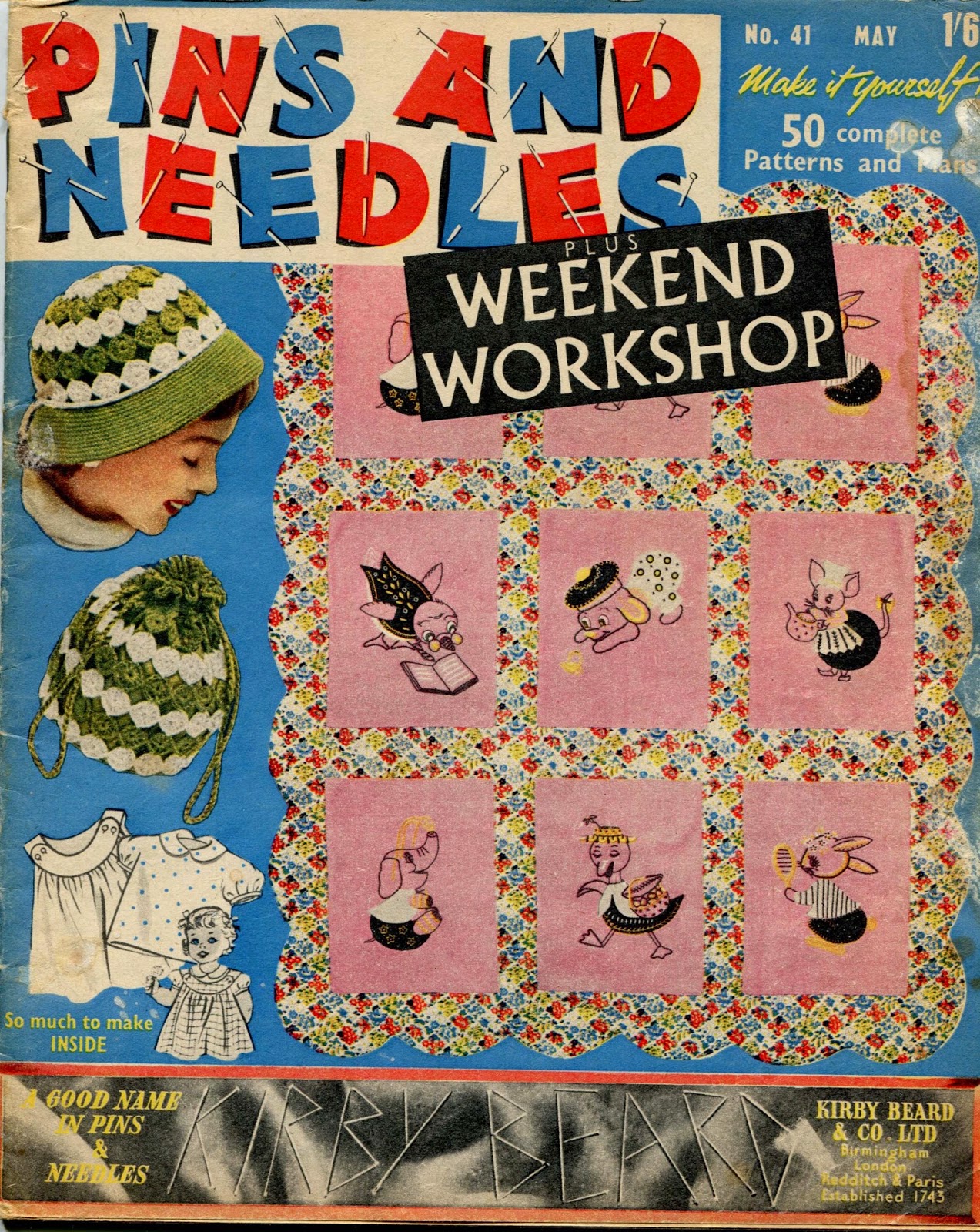
In September 1949 a new craft magazine hit the newsagents and it's name was PINS AND NEEDLES. With their bold and bright, almost cartoon like, covers, it must have been refreshing to see in the post war era.

There had been craft magazines before, most famously Stitchcraft, but nothing that had covered the range of crafts that Christine Veasey imagined for hers. I have 49 copies of this wonderful magazine ranging from the first edition until to No. 167 for December 1966. Published quarterly until November 1952 it then went bi-monthly. By March 1955 it had become successful enough to go to being a monthly publication which it continued to be into the 1980s (but under a different editor and company).

Initially it was mainly knitting and crochet with a bit of needlework or embroidery. There was the occasional wood working project, usually furniture but sometimes toys or garden items. As time passed, the subjects spread to include dress making, tatting, hair pin lace, and cooking. There was always a good coverage new sewing patterns that you could buy directly from the magazine offices. Christine Veasay went to America on regular trips and brought back ideas that were new and fresh and translated them to the British sense of taste.

In March 1955 a section called Home Making was introduced. Britain suffered a severe housing shortage during and after the Second World War but by 1951 houses were springing up all over the UK. Although a great many were council owned, tenants could decorate them as they chose and Pins and Needles was there to help. They offered decorating advice, what the latest colour schemes were, how to renovate old furniture, how to build new furniture: everything to make your house modern. Within a few months, the Home Making section had been re-branded into Weekend Workshop which was aimed more at men with 'Bertie Buggetwise' as their guide to making everything from glass topped coffee tables to built in wardrobes, and advice on how to plumb in sinks and put up tv aerials. 

Unlike Stitchcraft which was marketed by Patons and Baldwins to sell their yarns, Pins and Needles had to rely on other sources of income namely advertisers. Initially it was mainly yarn and handicraft suppliers with the odd advert for a knitting or sewing machine but as the years progressed more and more general catalogues, along with calls for people to become agents for them, became common. Whereas the early advertisers stressed their value for money and quality product, the latter ones start offering credit as a means of payment and offering the latest this and the newest that, possibly paving the way to the economic crash of 1973.

Aside from it being a crafting magazine, it also documented the changes that the British people were undergoing and reflected not just fashion trends but social and economic ones too. The Britain of the late 1940s was one of hardship, rationing and a country coming to terms with the cost, both financially and socially, of a global war. By 1957, full employment, a rise in consumerism, wages, and export led Harold MacMillan to make his 'never had it so good' speech and Britain was booming.


Saturday, 7 March 2015

Pins and Needles Covers

The covers of Pins and Needles

 
No. 1 Winter 1949
 No. 11 Summer 1952
No. 12 Autumn 1952
No. 15 March 1953
No. 17 July 1953
No. 18 September 1953
 No. 19 November 1953
No. 20 January 1954
No. 22 May 1954
No. 27 March 1955
No. 29 May 1955
No. 32 August 1955
 No. 35 November 1955
 No. 36 December 1955
No. 37 January 1956
No. 39 March 1956
 No. 40 April 1956
 No. 41 May 1956
 No. 49 January 1957
No. 52 April 1957
 No. 53 May 1957
No. 56 August 1957
No. 58 October 1957
No. 59 November 1957
No. 60 December 1957
No. 61 January 1958
No. 62 February 1958
No. 63 March 1958
 No. 64 April 1958
No. 65 May 1958
No. 66 June 1958
No. 68 August 1958
 
No. 69 September 1958
No. 72 December 1958
 No. 74 February 1959
No. 75 March 1959
No. 76 April 1959
 No. 82 October 1959
 
No. 83 November/December 1959
No. 86 March 1960
No. 92 September 1960
No. 98 March 1961
 No. 99 April 1961
No. 121 February 1963
No. 153 October 1965
No. 167 December 1966
No. 105 October 1961
No. 124 May 1963
No. 165 November 1966