A few ramblings about knitting, mainly vintage stuff and other bits and bobs. You can buy digital downloads of patterns directly from the site, or head over to either my Etsy store or Payhip

Saturday, 27 April 2019

Free Saturday (meant to be Friday) Pattern - Men's Gloves and Socks Woman's Weekly 25


That Bank Holiday on Monday has completely thrown me so I am a day behind. With storm Hannah blasting out overhead, I think that something appropriate is needed and this time it's for the blokes (well not just for them but you know what I mean). This men's glove and sock combo seemed just the thing to remind us that spring still can have a bite.

Click below for the pattern 


Friday, 19 April 2019

Free Pattern Friday - Bedjackets and Bedsocks Patons 678


I don't know why but I have a fascination for bedjackets. Possibly because they call to my 'lady of leisure' side who would be brought breakfast in bed on a chilly winter's morning, possible by the maid. The fire not having quite warmed the room, means I need something to cover my upper body as my delicate silk negligee just isn't up to the job. But I think that it's also because they tell of the history of a rather chilly island.


They tell of houses with no central heating and austerity and form part of the 20th century (and earlier) social history of Britain.
Most of the fancy old houses in Britain are still freezing as it costs a fortune to heat such a large space but it would be hasty to think that bedjackets are an item of clothing for the wealthy. Until recently most British homes were poorly heated. A small heater or open fire might warm the bedroom on the coldest nights and a fire in the living room but the rest of the house would be cold. A bedjacket was a practical solution to women of all classes to combat chilly times just before bed and first thing in the morning.

The patterns have their heyday in the 1940s and early 50s with just about every pattern company producing them. The light and airy nature of the bedjackets created a warm garment using larger than standard needles and would have also used less wool, which was rationed until the late 1940s. Many of the covers show quite a glamorous setting which I think was deliberate to give people a glimmer of pretty and feminine during a dark period of the world's history.

The patterns start to dwindle in the early 1950s which also ties into a boom in housing. Nye Bevan, the joint health and housing minister, insisted that there was a link between the health of the nation and housing. He insisted that good quality materials were used in new builds and that council built homes were linked to gas, water, and electric. Many of the council houses of this period were warmer due to better design, advancements in building technologies but also fuel prices had fallen so it was cheaper to heat the whole house for longer. The era of the bedjacket had passed and by the late 1960s they were seen as fuddy-duddy and only for old ladies.

I still have a soft spot for them though and hope that you do too.


Well that was longer than planned so here's your reward. This is a pattern from the very late 1940s or early 1950s judging from the hair styles. Click on the link below to get the pattern

Patons 578 - Bedjackets and Bedsocks


Friday, 12 April 2019

Free Pattern Friday - A Simple Rib Bestway 912


This Friday is a nice and simple pattern that a beginner could handle with easy and makes a great bit of telly knitting. The back and front are the same and it has those wonderful boxy sleeves of the early 40s that makes it a much have.

Although this is for a 34" bust, the finished garment is 29" so lots of negative easy and this should be easy to up-size if needed. One of the easiest ways is simply to go up a needle size but you could also use a thicker yarn to get the next size up. I think a combination of both should give you a couple of sizes difference but be careful that you don't get the fabric too loose or those sleeves could go floppy.

Click on the link below to get the pattern
Bestway 912 - A Jumper in Simple Rib

Tuesday, 9 April 2019

Soooooo . . . it's been a while

My word hasn't time flown? I hope everyone has been having fun. I have, well mostly. For the past couple of years I have been working away from home with only the weekend visits back to do my washing and attend comic cons with my fella (he does art and sells it but is a bit scared to give it a go on his own). This has left me with very little time to do anything.

However, I now have some time on my hands so thought that I would see if I can actually make a bit more of this wonderful blog and my pattern shop on etsy and Instagram and tumbler and Facebook, and I nearly forgot Pinterest. Look at me getting all fancy with social media.

I will try and post about my adventures in knitting, which fell by the wayside too but is being revived with the very lovely (and free) February Lady Sweater, as well as offering the occasional free vintage pattern to pique your interest and maybe even a KAL.
My time over the past week or so has mainly been spent tidying the living room. Yes, I know it shouldn't take that long but it's amazing what forms of distraction you can create when you don't want to do something. Anyway, I have to vacuum and find a couple more homes for bits and bobs and then I should be finished. And then I can try and tackle the bedroom. It has become the dumping ground for everything that doesn't have a place so it crammed. But the incentive there is that I know there are loads of fabulous patterns just wanting to see the world again.

Thursday, 6 July 2017

'Tis done. The ending of an epic


This is my depression. Not that this jumper has caused my depression but this is what my depression represents to me. Neat enough to get through life without drawing too much attention but random with loose ends and not complete.

It might sound strange, even I’m not sure if the analogy works but it kind of makes sense and kind of is close enough.

I’ve been knitting this jumper for a couple of years. Well I say knitting: I work at it for a few days and then put it down. I might sew a few ends in every now and again and try to kid myself that it’s getting sorted but really I’m just playing at the edges. Every time I think about finishing it, my heart sinks a little and I get a little more paralysed. If I can finish it I can move onto other things. I can find the joy in things, I will not have this hanging over me.

But every now and again I realise that the pressure is coming only from me. When I finish the jumper, my friend will be overjoyed to have it. She’s not demanding and my lackadaisical approach to making it hasn’t hurt out friendship so why am I dragging my feet?

Depression is selfish. This jumper is for someone else. A wonderful person but I just couldn't get round to finishing it for her. When it finally leaves my house, the depression will not go with it but I will always live with the legacy of making it and the small but many joys it brought me. It will exist in my somewhere and if I am careful, I will remember the things that it has taught me. Things do not have to be perfect. Everything doesn't have to be neatly wrapped up and finished and to do the things you love does make life so much better. To not get overwhelmed, that everything has an ending, that with support and a rough plan you can get through it, that things should always give you joy, and that friends are the most important of things.
It is not perfect but it is beautiful and it is loved


Monday, 6 June 2016

Finding the words to say . . . What?

I want to try and play with words again and see if I can make them make sense for other people. I want to write stories. I love language: the way people use (and abuse it), the tempo, the timbre, the nuances. I love the way that words feel. I shocked myself this morning though, when I realised how small my spoken vocabulary has become. I don't consider myself to be particularly eloquent but have always imagined that I got by pretty well but I found myself using 'amazing' several times when talking about the exploration of the Pacific by Polynesia peoples. What they did was amazing but there were other ways I could have described their ability to cover vast tracts of water. I was disappointed in myself and wish to find a way to use more, and better suited words. But how to go about such a challenge?

My bookcase is relatively light. I have some books I have returned to throughout my life - Littlenose; The Moomins; The Bone People; Victory; Jude the Obscure; The Gone Away World; Wolf Hall; Terry Pratchett is always there as is Iain (M.) Banks and of course my enduring love of vintage knitting books, but I have so few books.

Some people suggest that reading helps develop stronger language skills, but I am not a great, nor vociferous reader. I can read, and am not afraid of a complex or challenging read, but I am not one of those that always has a book on the go. Perhaps I should try to read a little more to see if it can help. I enjoy a wide range: science fiction, some fantasy, quite like modern fiction and dabble in the classics, will gladly open a book on poetry and non-fiction is something that I do enjoy. Yet where do I start? Many of the those that grace the best sellers lists I find dull and poorly written. The stories derivative, the characterisations unimagined and the language ungainly and more about the author than the story. They seem to have been written with the soul purpose to fill up critics list of 'must reads' but I wonder if the critics have read them.

I think that I am going to ask random strangers and friends to recommend a book for me to read and see if that expands my words and helps me write more myself. I know that there are those "100 books you should read before you die" type of lists but I find them a bit unoriginal (not the books, the lists) and I've probably already read many of them. I really would like to find new authors and stories so what is on your 'best books ever' list? And what do you think I should read next?

Wednesday, 27 April 2016

Spring is Springing . . .

https://drive.google.com/file/d/0B_tfKoGu9l5BS2wyeHpaUXFDNmc/view?usp=sharing
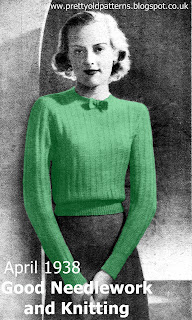
. . . and what better way to celebrate than with this great Spring Jumper from Good Needlework and Knitting 1938? 
Worked in a fancy rib with lovely long, close fitting sleeves and a  wee bow at the neck this is a classic 1930s design and will fit up to a 35" bust.
I love how a colour scheme is given for your whole outfit. Soft Tulip Green is suggested with a matching green angora woollen skirt; brown shoes; suntan stockings; and brown, green and yellow bangles. I like to think that those bangles are the big, chunky Bakelite ones that stack half way up your arm.

The second colour scheme is no less vibrant being Poker Red but toned down with a grey flannel skirt and jacket, grey suede shoes and belt and natural stockings.

Unusually the sleeves are worked from the top down so this could easily be made with shorter sleeves if you choose.

To download the pattern, just click on the image above


Friday, 25 March 2016

Family Woollies and a bit of history

Family Woollies
 I love these knitting supplements - this one was produced by Texet for Mother and Home in about 1937. Not only do you get a range of patterns also get a teeny glimpse of what was 'socially' acceptable for that era - history and knitting in one happy bundle. This one has the perfect nuclear family for the 1930s: Mum and Dad and 3 children and reflected the British government's attempts to raise the population.

Although it may not seem like an obvious campaign, images of the ideal family across a range of media presented what was desirable and in 1930s Britain, a larger family was desirable. Having a large population in the early part of the 20th century was seen as a positive thing as people were needed to work in manufacturing and agriculture but also meant that you had a population to buy the goods you made.

During the First World War the UK population had slumped and although there was a significant spike immediately afterwards, the birth rate soon dropped again. By the late 1920s the number of births had dropped to current levels, about 700,000 a year, and infant morality meant that 1 in 10 children didn't survive to their first birthdays so subtle campaigns throughout the 1930s were designed to encourage larger families (but not too large). These feed into all aspects of normal life including knitting patterns.

So there you have it: a little bit of history and a little bit of knitting - click on the cover and download the booklet with 9 family designs


Sunday, 17 January 2016

Surprise Sunday - 1940s Fair Isle Gloves

Since this was the scene that greeted me this morning, I thought that we could all do with a quick and pretty pattern  to help keep the cold away so I came up with gloves and mittens (all fitting an average hand, whatever that is). They are all made with quite a tight tension to keep your hands nice and warm. 

https://drive.google.com/file/d/0B_tfKoGu9l5BUHZzMjBMYWZ6WlU/view?usp=sharingEach pair use only an ounce (about 28g) of the main colour with the pattern being made up from oddments. Model A uses white, clover, lilac, rose, green, and peach as the contrasts. You can use what ever colours you have about as I think that it's probably only a few metres of each that you'll need for both gloves. Although the originals use 3-ply one of the thinner 4-ply wools would work equally well as long as you get the tension of 10.5 stitches to 1" using 2.75mm US 2 needles. Model B are the mittens and have this lovely toning patterns across the back of the hands in a light, medium and dark shade. The tension of these are a little bit tighter: 11 stitches to the inch using 2.75mm US 2 needles. Model C has brown, green, red, white, lemon and yellow and are worked as a tension of 10.5 stitches to 1 inch using 3mm US 2 needles.
To down load the pattern just click on the pattern and it should take you to the pdf.


Thursday, 14 January 2016

New In

I had a bit of a 30s splurge this week (it's probably my favourite era style wise). First was a great diagonal striped jumper with a stylish jabot (or decorative ruffle) from Munrospun from the mid 1930s. Munrospun was one of those companies that always produced high end patterns and was seen as being slightly more chic than many of the standard pattern companies. The pattern is for a 36" bust and uses a 4-ply so I think it could easily be resized by using larger needles and thicker wool. Then there is this wonderful lace blouse with a bust measurement of between 33" to 36" depending on how tight you like your clothes. The original was made from an artificial silk or rayon so if you want to match the drape, make sure that you choose something that slips.

This set of 5 jumpers, all different sizes that come from the Good Housekeeping Second Knitting Supplement. I found this tucked into a modern book and was so surprised to find it. The patterns are wonderful and probably date from the early 30s judging by the hair styles. My favourite is the diagonal striped jumper: I love the way they carry on through to the back and the way that one of the stripes coils down the arm. Each jumper has only one size but they are different, so a crafty use of different needles and yarn weights could get you a larger or smaller version. However, no tension is given so you really will just have to see how they feel.


On to the 1940s and there is this stunning cable and bobble twin set in a great petite size. To make this larger, just increase the number of repeats, but remember that you might also need to alter the arm scyth too so you could use a pattern in your size to work out that one.

For those of you that like a bit of lace, there is this gorgeous lace jumper pattern, also in a more petite size. This is a Bairnswear pattern, La Laine is the wool needed. Bairnwear did this frequently but probably the most recognised if 'Femina' which was another one of their wool lines.


My final 1940s pattern is this wonderful puff sleeve blouse or evening jacket with an all over shirred design. This one was designed by Munrospun and is, I think, extremely beautiful. I can just imagine it in a midnight blue yarn with a bit of glimmer to it and crystal buttons. The shirring is easy to achieve: it's just a matter of increasing and decreasing at the appropriate points to get the ripple effect.

To finish there is this fun 1950s 'sweater girl' jumper pattern with a nice open mesh lace. This is achieved by using a large (10mm) needle every few rows. This pattern has 2 sizes 34" and 36" but I think that it might be tricky to make it larger by just using larger needles or yarn so you might have to work out the maths if you want to resize it.